
What is ROE ?Explain in layman’s language, What should be the ideal ROE for a good company to invest in?
ROE stands for Return on Equity.
It tells you:
“How much profit a company makes using the money invested by its shareholders.”
🧠 Imagine This:
Let’s say you and some friends invest ₹10 lakh to start a small business (your equity).
At the end of the year, you earn a profit of ₹1.5 lakh.
Then:
ROE=Profit/Equity=₹1.5 lakh/₹10 lakh=15%
This means:
👉 You earned 15% return on your own money in one year.
A higher ROE = better use of your money.
💡 ROE Formula:

- Net Profit = Company’s income after all expenses and tax
- Shareholders’ Equity = The total money invested by the owners + profits kept in the business
🛍️ Example with a Company:
- A company has ₹500 crore equity (from shareholders)
- It earns ₹75 crore profit this year
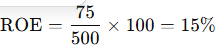
So, for every ₹1 invested by owners, the company made ₹0.15 profit.
✅ What is an Ideal ROE for Investment?
| ROE | Meaning | Good or Bad? |
| > 20% | Excellent | Company uses capital very efficiently |
| 15% – 20% | Very Good | Strong performer, likely consistent |
| 10% – 15% | Decent | Acceptable if other factors are solid |
| < 10% | Weak | Company may be inefficient or struggling |
🧾 Ideal ROE by Sector:
| Sector | Ideal ROE |
| Banks / Insurance | 12% – 18% |
| Consumer Goods / FMCG | 15% – 25% |
| Tech / Pharma | 15% – 30% |
| Capital-Heavy Industries (Power, Infra) | 8% – 12% |
⚠️ But Be Careful:
- Very high ROE (>30%) could be due to low equity (high debt), which adds risk.
- Always check debt levels with ROE.
- ROE should be consistent over years, not just once.
🎯 Final Summary (Like Talking to a Friend):
ROE shows how well a company uses its own money to make profit.
A good company usually has ROE between 15% to 20% or more.
It’s like saying:
“For every ₹1 the company owns, how much ₹ it earns back?”